
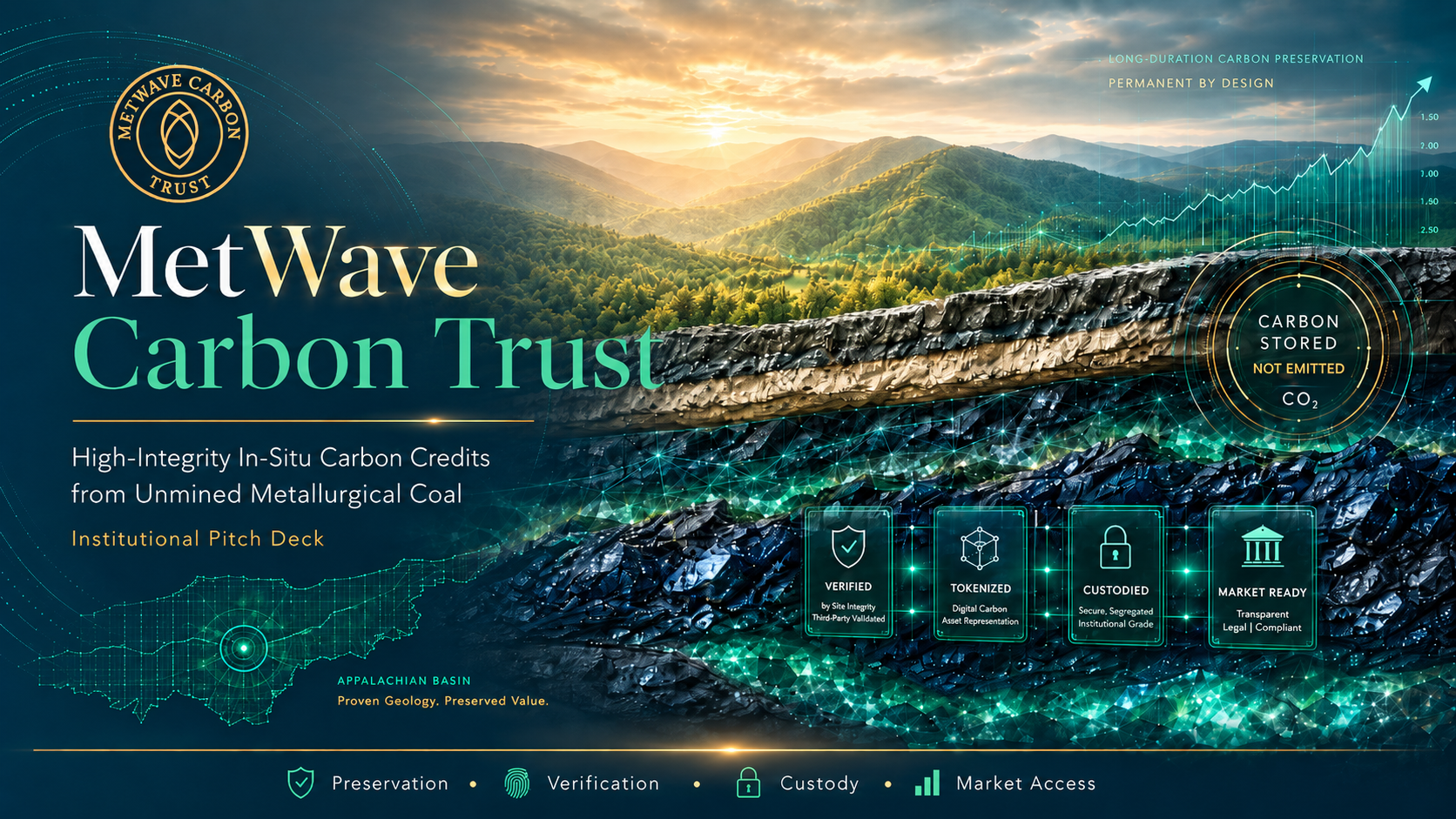
Markets learned to finance extraction.
For generations, industrial economies created value primarily through the extraction and utilization of carbon-bearing natural resources. Coal, oil, natural gas, and timber powered economic growth, industrial development, and modern infrastructure.
Financial systems evolved sophisticated mechanisms for valuing extraction, production, and consumption. Comparatively little economic value was assigned to preserving carbon resources responsibly in place over long periods of time.
What extraction-era finance built
- Commodity markets and forward curves
- Lease structures and severance tax regimes
- Project finance for production and transport
- Reserves accounting and SEC disclosure
- Royalty and overriding-interest instruments
What it did not build
- Market-priced compensation for non-extraction
- Custodial registries for embedded carbon
- Independent MRV for in-situ permanence
- Governance instruments for stewardship
Environmental markets are evolving.
As participation has expanded, market participants have become more attentive to questions of permanence, verification, additionality, double-counting, governance, and long-term accountability. These concerns do not reflect failure — they reflect the natural maturation of a rapidly evolving environmental asset class.
Trust as infrastructure
Carbon credits derive their value not from physical commodities alone, but from confidence that the underlying environmental claims are measurable, verifiable, durable, and transparently governed.
Higher-integrity expectations
Buyers, registries, validators, and institutional participants increasingly seek environmental assets supported by conservative methodologies, independent validation, transparent MRV, and reversal-risk management.
A missing category
Most existing frameworks focus on emissions reductions or removal after carbon has entered the atmosphere. Comparatively less attention has been directed toward preserving embedded carbon resources before extraction and combustion.
What if markets could also reward preservation?
Historically, markets rewarded the release of embedded carbon through extraction and combustion. Emerging environmental markets may now allow value to be associated with preserving certain carbon resources responsibly — under measurable stewardship frameworks designed to prevent or defer future emissions.
This evolution creates the possibility that preservation itself may begin functioning as an economically recognized activity when supported by transparent governance, conservative accounting, and independently verifiable environmental claims.
Not passive inactivity — actively governed stewardship
- Legal enforceability of preservation commitments
- Operational monitoring of stewardship areas
- Governance structures and custodial arrangements
- Risk-management and reversal procedures
- Transparent verification over time
A new category: preservation finance.
Preservation finance seeks to establish market-based mechanisms capable of supporting the long-term stewardship of embedded carbon resources through measurable preservation commitments, transparent governance, independently validated claims, and durable accountability structures.
Measurable
Conservative accounting tied to specifically allocated reserve volumes — not generalized regional estimates.
Transparent
Independently reviewable assumptions, calculation pathways, and monitoring outputs at every layer.
Independently validated
External technical scrutiny and continuous refinement — scrutiny as part of building trust.
Durably governed
Custodial controls, multi-party approvals, reversal management, registry-based reporting.
From conceptual objective to an operationally governed environmental management system.
The MetWave Preservation Stewardship Framework combines legal controls, environmental monitoring, validation procedures, governance structures, and registry integration into a coordinated model designed to support measurable and independently verifiable stewardship claims.
Layered, not single-mechanism
Multiple forms of oversight reinforce one another operationally — legal, technological, governance, and registry controls together.
Bounded preservation claims
Claims are tied to specifically allocated resource volumes under documented stewardship — not broad regional carbon estimates.
Conservative by design
Where uncertainty exists, the framework applies conservative assumptions intended to strengthen credibility rather than maximize issuance volume.
The framework was built around a principle increasingly relevant across environmental markets: long-term confidence in preservation-oriented environmental assets depends not only upon environmental objectives, but upon the credibility of the systems used to measure, govern, validate, and steward preservation commitments over time.
Six interconnected components of preservation accountability.
Resource Identification & Allocation
Geological characterization, reserve analysis, legal-rights evaluation, and clearly defined stewardship boundaries. Crediting is bounded to allocated volumes — not regional estimates.
Legal Preservation Controls
Non-extraction covenants, preservation agreements, custody arrangements, and governance restrictions tied to carbon rights — converting intent into enforceable obligations.
Monitoring, Reporting & Verification (MRV)
Satellite observation (Sentinel-2 optical + Sentinel-1 SAR), geospatial analysis, persistence-filtered disturbance detection, periodic verification — observable stewardship over time.
Independent Validation & Verification
Third-party review of accounting, monitoring, legal structures, and governance — designed for ISO 14064-2:2019 conformance and continuous methodological refinement.
Governance & Custody
Multi-party approvals, custodial structures, audit trails, reversal-response procedures, and buffer-pool management — stewardship that remains governable as well as measurable.
Registry-Based Asset Management
Serialization, issuance tracking, transparent reporting, and double-counting mitigation through integration with the Northern Trust Carbon Registry (NTCR).
Wimberly Branch · Jackson County, Alabama.
The initial implementation of the MetWave framework focuses on a defined carbon-bearing reserve within the Appalachian coal region of Alabama. The project combines legal preservation controls, independently reviewed accounting, satellite-based MRV, governance procedures, and registry onboarding into a practical stewardship model under real-world conditions.
1,894,300 tons
2.819 tCO₂e/ton
443,223 /yr
4,432,226 tCO₂e
Project specifications
- Project name
- MetWave In-Situ Carbon Preservation & Tokenized Governance Project
- Location
- Wimberly Branch, Jackson County, Alabama, USA
- Boundary
- PLSS legal description · Township 1 South, Range 7 East & 8 East
- Lessee
- PJKT72, LLC (associated: MetWave Mining Company LLC)
- Mineral lessor
- Chester Franklin and Judy Wilkerson
- Crediting period
- 10 years (1 Jan 2025 – 31 Dec 2034)
- Project type
- GHG avoidance — in-situ preservation, no extraction
Stewardship controls in place
- Non-extraction covenant recorded under Alabama law
- Formal separation of carbon rights from mineral rights
- Custody and escrow controls with Northern Trust
- Multi-signature governance for any extraction-status action
- ~20% buffer pool reserved against reversal risk
- 2% leakage deduction applied to net issuance
- Quarterly satellite surveillance with Run-Log archiving
Limited in scope by design — the project is intended as operational proof of concept, not the final form of preservation finance.
Validated by Bureau Veritas. Conformant to ISO 14064-2:2019.
Bureau Veritas Certification conducted the validation and verification of the project under ISO 14064-2:2019 and ISO 14064-3:2019. The Verification Report — USA-VER/01/2026, issued 11 May 2026 — confirms that MetWave LLC has correctly applied the principles of the standard within the defined scope.
Process discipline: 12 Clarification Requests and 3 Corrective Action Requests were raised, addressed, and closed during validation — refinements to allocation boundaries, reversal procedures, monitoring definitions, emissions factors, and stewardship documentation. Scrutiny was treated as part of building trust.
What the V&V confirmed
- Project boundary defined and enforceable under Alabama mineral lease
- Baseline scenario plausible: extraction permitted under SMCRA, not mandated; project in regulatory surplus
- Additionality demonstrated under Methodological Tool 27 v11.0 and EB 62 Annex 05 — investment analysis confirms financial unattractiveness absent carbon revenue
- CO₂ conversion factor of 2.819 tCO₂e/ton (EPA Emission Factors Hub, Jan 2025)
- Materiality threshold of ±5% met; limited assurance issued
- Stakeholder grievance mechanism in place; no recorded grievances
- SDGs 13 & 15 contributions documented and verifiable
A repeatable, audit-ready monitoring protocol.
The Jackson County Satellite Surveillance and Disturbance Monitoring System runs on a quarterly cadence, comparing the most recent completed quarter against the same quarter in the prior year — seasonal alignment that minimizes false signals from vegetation cycles.
| Layer | Method | Detection threshold | Output |
|---|---|---|---|
| NDVI — vegetation | Sentinel-2 optical, 10 m resolution | NDVI drop ≥ 0.20 | Vegetation-loss flag |
| BSI — bare soil | Sentinel-2 optical | BSI increase ≥ 0.15 | Soil-exposure flag |
| SAR — structural | Sentinel-1 C-band radar (cloud-independent) | Backscatter change ≥ 1.5 dB | Structural-change flag |
| Persistence | Two sub-period confirmation | Must trigger in both windows | Reduces transient noise |
| MMU | Connected-pixel clustering | ≥ ~1,000 m² · materiality at 1 acre | Filters single-pixel artifacts |
| SAR corroboration | Cross-sensor validation | BSI-only must exceed SAR overlap 0.20 | Strengthens defensibility |
Evidence bundle
Each run produces: Alerts CSV, GeoJSON polygons, SHP, Summary Figure, and Run Log CSV — all prefixed with a unique Run ID for traceability.
Run-log discipline
AOI asset reference, date windows, thresholds, MMU, SAR overlap, polygon count, total acreage, trigger distribution, and timestamp recorded for every execution.
Registry alignment
Outputs structured for integration with ISO 14064-2:2019, VCS, and ICR registry-based MRV systems. Minimum 7-year retention under version-controlled custody.
One early step within a larger exploration.
The Alabama project is an intentionally limited first implementation. As environmental markets continue evolving, preservation stewardship may eventually extend beyond individual projects toward standardized systems capable of supporting broader participation across multiple resource classes, jurisdictions, and stewardship applications.
Standardized MRV
Common protocols for satellite-based disturbance detection adaptable across geological and ecological systems.
Stewardship registries
Custody, serialization, and accountability infrastructure capable of supporting transparent environmental asset management at larger scales.
Reversal management
Buffer-pool structures and escalation procedures designed to absorb reversal events across multi-project stewardship portfolios.
Custody & governance protocols
Multi-party approvals and custodial controls extensible to additional resource owners and institutional participants.
Cross-market interoperability
Methodology designed for crosswalk into UNFCCC Article 6, EU ETS, India CCTS, and Canada OBPS compulsory carbon frameworks.
Regional economic optionality
Preservation-oriented participation models capable of complementing existing economic structures in resource-bearing regions.
Framing remains cautious by design: preservation stewardship is presented as one component within a broader ecosystem of climate-related financial and environmental frameworks — not a replacement for emissions reductions, renewable energy, or carbon removal.
Stewardship credibility is built, not declared.
Conservative quantification
Bounded allocation, leakage deductions, buffer structures, independently sourced emissions factors.
Independent review
Bureau Veritas validation; Internal Technical Review prior to NTCR submission.
Transparent monitoring
Quarterly satellite MRV with Run-Log discipline and 7-year archival retention.
Durable governance
Custody and escrow, multi-signature approvals, reversal triggers, registry-based reporting.
A framework designed for thoughtful early engagement.
Preservation finance will develop through collaboration among validators, registries, stewardship organizations, institutional participants, resource owners, and environmental market participants willing to engage thoughtfully with evolving frameworks. The Alabama project is a venue for that engagement.
Institutional buyers
Sophisticated participants seeking high-integrity, independently validated, conservatively quantified credits issued under ISO 14064-2:2019 and registered with the Northern Trust Carbon Registry.
- Verifier: Bureau Veritas (USA-VER/01/2026)
- Registry: NTCR onboarding in progress
- Compliance crosswalk: Article 6, EU ETS, CCTS, OBPS
Resource owners
Mineral-rights holders considering whether stewardship-oriented participation may complement existing options, under transparent custody and governance terms.
- Intake review with three documents
- Reserve ownership / lease rights
- Core sample data & quantity; SGS coal analysis
Registries & validators
Counterparts engaging with an early operational model intended to inform standards and methodologies for preservation-oriented environmental assets.
- NTCR onboarding partnership
- ISO 14064-2/3 validation cycle
- ICMCI standards alignment
From validation toward issuance.
PDD v1.1
Project Design Document submitted 5 May 2026.
Bureau Veritas V&V
USA-VER/01/2026, rev. 02, issued 11 May 2026.
Internal Technical Review
BV ITR prior to NTCR submission.
NTCR Onboarding
Registry submission and serialization setup.
Issuance
First monitoring-period credits: 588,940 tCO₂e for 1 Jan 2025 – 30 Apr 2026.
Quarterly MRV
Satellite surveillance cycles with Run-Log archival.
If preservation can be measured, governed, and verified — markets can recognize it.
Historically, markets assigned economic value primarily to the extraction and consumption of carbon-bearing resources. Emerging stewardship frameworks may increasingly allow markets to recognize value in the responsible preservation and long-term management of embedded carbon itself.
Quantification, references, and protocols.
10-year issuance schedule
| Year | BE (tCO₂e) | PE (tCO₂e) | ER (tCO₂e) | Cumulative |
|---|---|---|---|---|
| 2025 | 443,222.63 | 0.00 | 443,222.63 | 443,222.63 |
| 2026 | 443,222.63 | 0.00 | 443,222.63 | 886,445.26 |
| 2027 | 443,222.63 | 0.00 | 443,222.63 | 1,329,667.89 |
| 2028 | 443,222.63 | 0.00 | 443,222.63 | 1,772,890.52 |
| 2029 | 443,222.63 | 0.00 | 443,222.63 | 2,216,113.15 |
| 2030 | 443,222.63 | 0.00 | 443,222.63 | 2,659,335.78 |
| 2031 | 443,222.63 | 0.00 | 443,222.63 | 3,102,558.41 |
| 2032 | 443,222.63 | 0.00 | 443,222.63 | 3,545,781.04 |
| 2033 | 443,222.63 | 0.00 | 443,222.63 | 3,989,003.67 |
| 2034 | 443,222.63 | 0.00 | 443,222.63 | 4,432,226.30 |
References & protocols
- Quantification Std.
- ISO 14064-2:2019
- Verification Std.
- ISO 14064-3:2019
- Verifier
- Bureau Veritas Certification
- Report
- USA-VER/01/2026, rev. 02
- Additionality
- CDM Methodological Tool 27 (v11.0); EB 62 Annex 05
- Emission factor
- EPA Emission Factors Hub, 15 January 2025 (2.819 tCO₂e/short ton)
- Mining law
- SMCRA 1977; Title 9 Ch. 16 Code of Alabama; 30 CFR Part 901
- Reserve framework
- USGS Circular 891
- MRV protocol
- Jackson County Coal Reserve Satellite Surveillance & Disturbance Monitoring System, V2
- Registry
- Northern Trust Carbon Registry (NTCR) — onboarding
- Buffer pool
- ~20% reserved per NTCR protocol
- Leakage
- 2% deduction applied to net issuance
- SDG alignment
- SDG 13 (Climate Action); SDG 15 (Life on Land)
The verifier's opinion: "the GHG quantification methodology applied by project owner is technically sound, transparent, and conservative; the reported GHG emission reductions are calculated in accordance with ISO 14064-2:2019 and aligned with NTCR requirements; the GHG assertion presented is reasonable and free from material misstatement at the agreed level of assurance."